
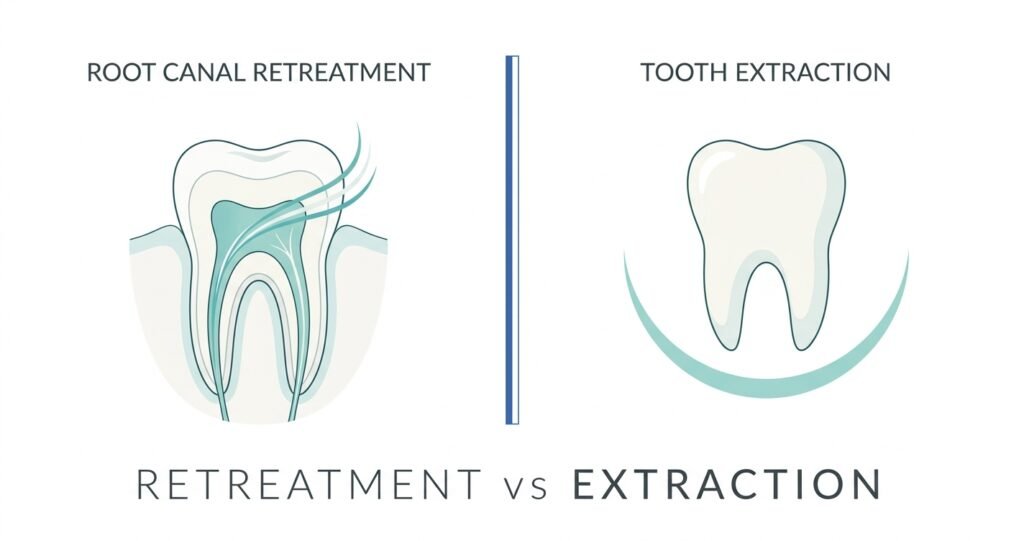
If your root canal did not heal the way it should have, you are not alone. Many patients in Beverly Hills and surrounding areas like Northridge face this exact situation. The good news is that a failed root canal does not automatically mean you lose your tooth. In most cases, you still have excellent options. At our practice, Dr. Farshid Ariz, DMD, works closely with patients to determine whether retreatment or extraction after a failed root canal is the best path forward. Every case is different, and a careful evaluation makes all the difference in achieving a great outcome.
What Does a Failed Root Canal Actually Mean?
A root canal is considered “failed” when the treated tooth does not heal properly or develops a new infection. This can happen months or even years after the original procedure. Symptoms may include persistent pain, swelling, tenderness when chewing, or a small bump on the gums near the tooth.
There are several reasons why a root canal may not succeed. Some of the most common include:
- Missed canals: Some teeth have complex anatomy with extra canals that are difficult to find.
- Incomplete cleaning: Bacteria may remain inside the tooth if the canals were not fully cleaned.
- Cracked root: A hairline fracture in the root can allow bacteria to re-enter.
- Delayed or failed restoration: If the crown or filling was not placed quickly enough, the tooth can become reinfected.
- New decay: A new cavity can develop around the existing restoration and expose the canals to bacteria again.
Understanding the cause of the failure is the first step toward choosing the right solution. Advanced imaging, such as cone beam computed tomography (CBCT), gives us a detailed three-dimensional view of the tooth and surrounding bone. This technology helps us identify the exact problem so we can recommend the most effective treatment.
Endodontic Retreatment: Saving Your Natural Tooth
When a previously treated tooth develops problems, endodontic retreatment is often the preferred approach. The goal is simple — remove the old filling material from inside the tooth, clean and disinfect the canals again, and seal them properly.
Retreatment is a strong option when the tooth structure is still healthy enough to support a new restoration. According to the American Association of Endodontists, retreatment has a high success rate, and saving the natural tooth is almost always the best choice when it is possible.
Research published in the Journal of Endodontics shows that non-surgical retreatment has a success rate ranging from 74% to 98%, depending on the specific clinical conditions involved (Ng et al., 2008). Those numbers are very encouraging. They tell us that most teeth can be saved with proper retreatment by a skilled endodontist.
During the procedure, we reopen the tooth, carefully remove the previous filling material, and look for any canals that may have been missed. We use an operating microscope for magnification and enhanced visualization. Once every canal is located and thoroughly cleaned, the tooth is filled again and sealed. A new crown is usually placed afterward to protect the tooth long-term.
For patients in Northridge and the greater Los Angeles area, retreatment can be completed comfortably in one or two visits. Most patients return to their normal routine within a day or two. If you are exploring whether your failed root canal needs retreatment or extraction, retreatment should always be evaluated first.
When Is Extraction the Better Choice?
There are situations where retreatment is not the best option. In these cases, extraction may be the smarter path. Here are some scenarios where removal of the tooth makes more sense:
- Severe vertical root fracture: A crack running along the length of the root usually cannot be repaired.
- Extensive bone loss: If the infection has destroyed too much bone around the tooth, saving it becomes unpredictable.
- Non-restorable tooth: If there is not enough healthy tooth structure remaining to hold a crown, the tooth cannot function properly even if the root canal is successful.
- Perforations: Large perforations in the root that cannot be repaired may make retreatment impractical.
Extraction is not a failure. Sometimes it is the most responsible recommendation. When a tooth is removed, there are excellent replacement options, including dental implants and bridges. A dental implant, for example, can look, feel, and function like a natural tooth. According to a systematic review in Clinical Oral Implants Research, dental implants have a 10-year survival rate of approximately 96.4% (Pjetursson et al., 2012). That means implants are a highly reliable long-term solution when extraction is necessary.
We always discuss tooth replacement options before proceeding with an extraction. Planning ahead ensures the best possible outcome and avoids bone loss in the extraction site.
Retreatment vs. Extraction: How We Decide
The decision between root canal retreatment and extraction comes down to a few key factors. We look at everything carefully before making a recommendation.
- Tooth condition: Is there enough healthy structure to support a restoration?
- Root integrity: Are the roots intact, or is there a fracture?
- Bone health: Is there adequate bone surrounding the tooth?
- Patient goals: What does the patient prefer, and what fits their overall dental plan?
- Cost considerations: Retreatment plus a crown may cost less than extraction, implant, and implant crown combined.
Whenever possible, keeping your natural tooth is the ideal choice. Your natural tooth has a ligament around it called the periodontal ligament. This ligament provides cushioning and sensory feedback that an implant cannot replicate. It also helps preserve the bone in your jaw naturally.
For patients visiting us from Northridge and neighboring communities, we take the time to explain every option clearly. We want you to feel confident and informed about your decision. You can learn more about root canal treatment and what to expect on our website.
What to Expect During a Retreatment Procedure
If retreatment is the right choice for you, here is what the process typically looks like:
- Step 1: We numb the area completely so you feel no pain.
- Step 2: The existing crown or filling is removed to access the inside of the tooth.
- Step 3: The old root canal filling material is carefully taken out.
- Step 4: We use magnification and advanced instruments to locate and clean all canals.
- Step 5: The canals are disinfected, shaped, and sealed with new filling material.
- Step 6: A temporary or permanent restoration is placed.
Recovery is usually quick. Most patients experience only mild soreness for a few days. Over-the-counter pain relievers are usually enough to manage any discomfort. We follow up to make sure healing is progressing well.
If you want a deeper understanding of what happens when a tooth needs additional care, our guide on what to expect during root canal retreatment walks you through each step in detail.
Why Choosing the Right Specialist Matters
Not every dentist performs retreatments. Endodontists are dental specialists who complete two to three additional years of training beyond dental school. This advanced education focuses specifically on diagnosing and treating problems inside the tooth.
An experienced endodontist uses tools like the operating microscope, CBCT imaging, and ultrasonic instruments. These technologies make it possible to find hidden canals, remove old filling materials safely, and treat complex anatomy. Choosing the right specialist can make the difference between saving and losing your tooth.
Whether you live in Beverly Hills, Northridge, or anywhere else in the Los Angeles area, we are here to help. A failed root canal can feel stressful, but with the right evaluation and treatment plan, the outcome can be excellent. The key is getting an accurate diagnosis and working with a specialist who has the training and technology to handle your specific situation.
Frequently Asked Questions
Can a failed root canal be fixed without pulling the tooth?
Yes, in many cases a failed root canal can be fixed through endodontic retreatment. The endodontist reopens the tooth, removes the old filling material, cleans and disinfects the canals again, and seals them with new material. This approach has a high success rate and allows you to keep your natural tooth.
How do I know if I need retreatment or extraction after a failed root canal?
Your endodontist will evaluate several factors, including the condition of the remaining tooth structure, the health of the surrounding bone, and whether the root is fractured. Advanced imaging like CBCT scans helps make an accurate diagnosis. Based on these findings, your specialist will recommend the option that gives you the best long-term outcome.
Is root canal retreatment painful?
Root canal retreatment is performed under local anesthesia, so you should not feel pain during the procedure. Most patients report only mild soreness for a few days afterward, which is easily managed with over-the-counter pain medication. The experience is very similar to having a regular root canal.
How long does a retreated root canal last?
A successfully retreated root canal can last a lifetime with proper care. This includes getting a well-fitting crown placed promptly and maintaining good oral hygiene. Regular dental checkups help ensure the tooth stays healthy over the long term.
What happens if I choose extraction instead of retreatment?
If you choose extraction, the tooth is removed and you will need a replacement to maintain proper function and prevent shifting of surrounding teeth. The most common replacement options are dental implants and fixed bridges. Your endodontist and restorative dentist will work together to plan the best replacement solution for your situation.
Written by: Dr. Farshid Ariz, DMD